

Why it’s important to have strong core muscles after 60 and easy exercises you can do right now
Strong core muscles are more than just abs. They help stabilize your spine and pelvis, improve your balance, lower your risk of falling, make everyday tasks easier, and ease back pain. A functional core helps people over 60 stay independent and feel positive about themselves.
Advantages
Less risk of falling and better balance
Easier to bend, reach, carry, and get up from chairs
Less pain in the lower back and better posture
Easier to walk and climb stairs
Better breathing and support for the pelvic floor
First, safety
If you’ve had surgery recently, have uncontrolled high blood pressure, severe osteoporosis, or pain in your back, hips, or knees, talk to your doctor.
Begin slowly, and if you feel sharp pain, shortness of breath, dizziness, or tingling, stop.
Pay attention to moving slowly and steadily and breathing steadily.
When you need to, lean on a chair, wall, or bed.
How many times
Try to have 2 to 4 sessions a week.
Start with 1 to 2 sets of 8 to 12 reps for each exercise (or the hold times given), and then slowly work your way up to 2 to 3 sets.
Take a break of 30 to 90 seconds between sets.
Core routine that’s simple for beginners and safe for most people over 60
Breathing through your diaphragm (2–3 minutes)
Get comfortable by sitting or lying down. Take a deep breath in through your nose and out through your mouth. Helps get deep core muscles to work.
Pelvic tilts (on the floor or in a chair) for 8 to 12 reps
You can either lie on your back with your knees bent or sit up straight. Tighten your lower belly to gently flatten your lower back against the surface, then let go.
8–12 reps on each side of heel slides
Lying on your back with your knees bent. Slowly pull one heel away until the leg straightens a little, then pull it back, keeping the pelvis still.
10 to 20 marches while sitting or lying down
Raise one knee at a time while keeping your pelvis still and your core tight.
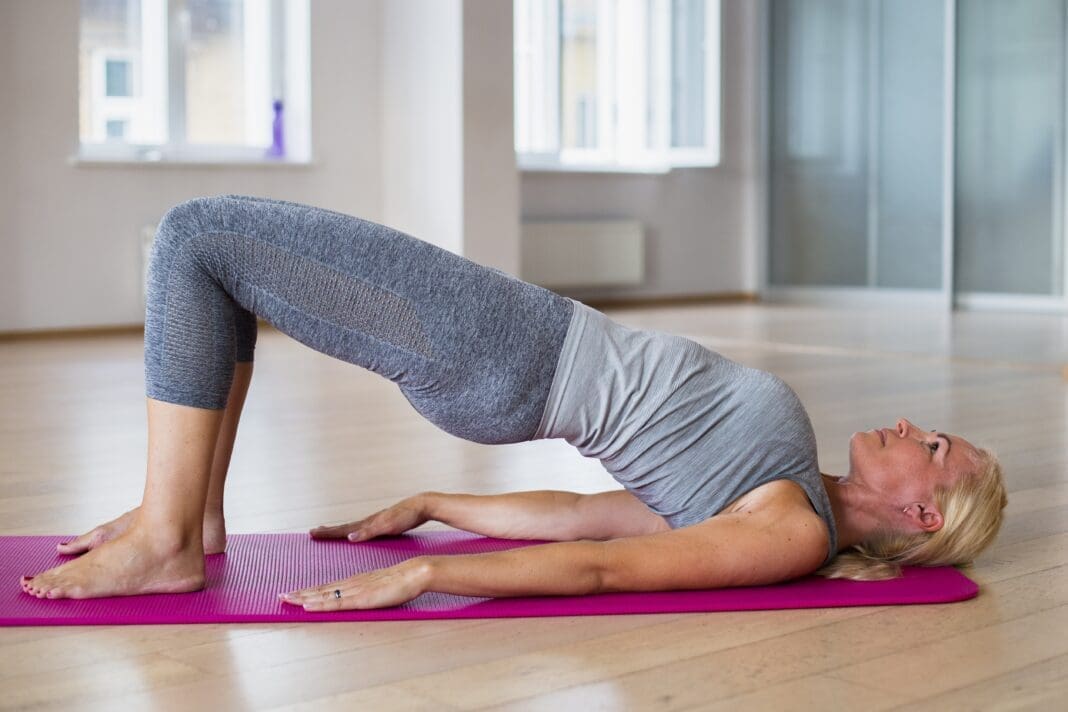
8–12 reps of the glute bridge
Lying on your back with your knees bent, lift your hips until your body is in a straight line from your shoulders to your knees. Then, slowly lower them.
Bird-dog (on your hands and knees or standing against a wall for balance)—6 to 10 times on each side.
Keep your hips level and your spine straight as you extend your opposite arm and leg. Keep it for 2 to 3 seconds.
Dead bug (changed) — 6–10 times on each side
Knees bent and lying on your back. Keep your low back in contact with the floor and your core tight as you lower one heel.
Standing anti-rotation hold (pall of press) with a band or a light object in each hand for 10 to 20 seconds on each side.
Press straight out from your chest and don’t let it rotate to train your core for everyday tasks.
Perform side-lying hip abduction exercises to enhance stability in both the core and the hips on each side. 8–12 times on each side
Lay on your side and lift your top leg while keeping your hips stacked.
Changes
Slowly raise the number of reps, sets, or hold times.
As your strength grows, switch from supported versions (seated and wall) to ground versions.
When you’re ready, add light resistance (bands) or move your body more.
Advice for success
Put quality ahead of quantity: move slowly and with control.
Make core work a part of your daily life by sitting up straight while you get dressed and using your core when you lift groceries.
For the best results, do these activities with balance, flexibility, and aerobic exercise.
Keep track of small victories, like easier transfers, less pain, and steadier walking.
When should you seek help from a professional?
If the pain doesn’t go away or you have a medical condition like spinal stenosis or a recent fracture, see a physical therapist for a program that is right for you.
In conclusion, it is possible and very helpful to build core strength after age 60. If you start slowly and keep going, you should see better balance, less pain, and easier movement throughout the day.
Why Does Core Strength Matters For People Over Age 60

Author
